
When people remember Yuzu, they usually talk about frame rates, game compatibility, or new builds dropping on GitHub. What rarely gets discussed is the telemetry system that quietly shaped a lot of those improvements.
Yuzu emulator was open-source. Anyone could browse issues, submit fixes, or read through development discussions. That openness was great, but messy. Bug reports showed up everywhere: Discord chats, forum threads, GitHub issues, random DMs. Some were detailed. Many weren’t. It wasn’t always clear which crashes were widespread and which were one-off problems.
Telemetry was introduced to cut through that noise.
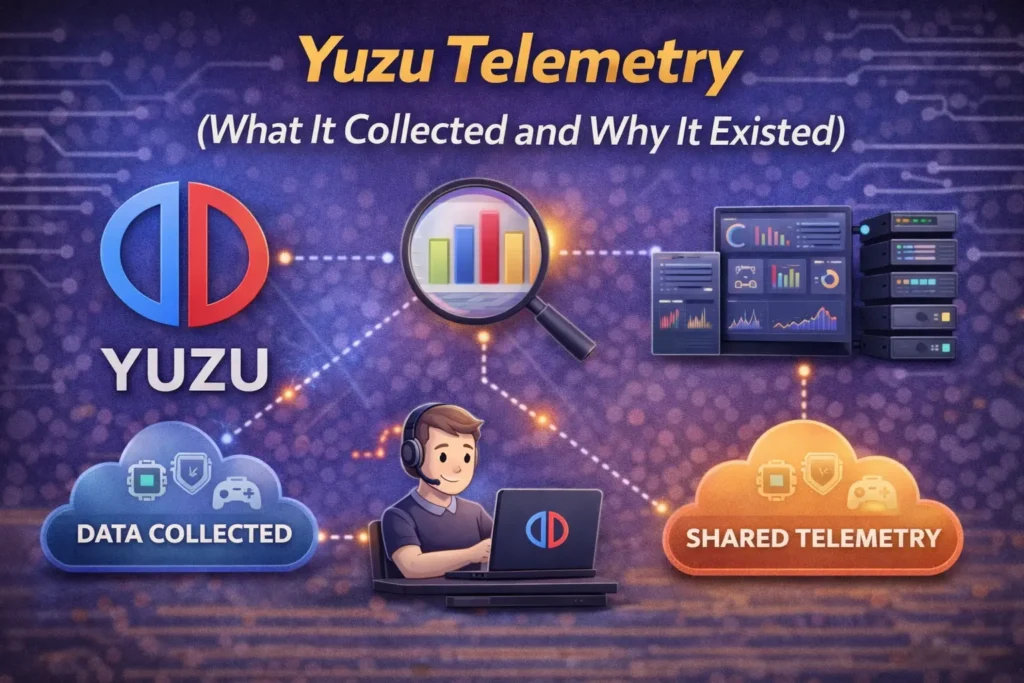
Why Telemetry Was Introduced
The idea wasn’t complicated: gather real usage data so developers could focus on what actually mattered.
Instead of guessing which games were unstable or relying solely on users to upload logs, the team could see patterns:
- Which titles were crashing the most
- How often those crashes happened
- What hardware people were using
- How performance differed between systems
That made prioritizing fixes far more practical. If thousands of users were hitting the same crash, it jumped to the top of the list.
The project was transparent about this. The team explained what would be collected and why, which was important for an open-source community built on trust.
What Information Did Yuzu Telemetry Collect?
If you enabled telemetry, it gathered technical details related to emulation, not personal content.
Emulator version
Which build you were running. Helpful for spotting regressions or bugs tied to specific updates.
Configuration settings
Graphics backend, resolution scaling, shader options, and other emulator tweaks. This helped determine whether issues came from default settings or custom setups.
Performance data
Frame rates, stability information, runtime behavior, enough to compare how different CPUs and GPUs handled the same game.
Basic system specs
CPU model, GPU model, operating system. Nothing like personal files or browsing history, just hardware info relevant to performance.
Crash reports
When something broke, telemetry could capture the error type and technical context automatically. That saved time compared to waiting for users to manually export and upload logs.
Was the Data Anonymous?
Yes. This is where most concerns came from.
Yuzu didn’t attach telemetry to personal identities. Instead, it created a random Telemetry ID. That ID wasn’t linked to names or personal accounts. It could be reset at any time, and regenerating it essentially created a fresh identity in the system.
No IP logging tied to a profile. No personal documents. Just technical data associated with a random identifier.
Can You Disable Telemetry?
Yes. Completely optional.
You could disable telemetry in the settings, and the emulator would continue to function normally. Nothing was locked behind participation.
That opt-in structure mattered. People who wanted to help improve compatibility could do so. Those who preferred not to share anything could opt out without penalty.
Why Telemetry Was Valuable for Development
For developers, having aggregated data changed everything.
Instead of chasing scattered reports, they could:
- Spot the most unstable games quickly
- Identify GPU-specific or driver-specific issues
- Detect performance regressions after updates
- Allocate limited development time more efficiently
Manual bug reports are often incomplete like missing logs, unclear steps, wrong version numbers. Automated telemetry filled in those gaps with consistent data.
Of course, it only worked if enough users kept it enabled. The more data available, the clearer the patterns became.
Error Logs and Manual Reporting
In addition to telemetry, Yuzu also generated exportable error logs. Users could manually send these logs to developers for deeper analysis. This provided another layer of troubleshooting beyond automated reporting.
Important Disclaimer
Yuzu is no longer in active development following legal action involving the team. This explanation is purely informational, describing how the telemetry system functioned while the project was active.
Final Thoughts
Telemetry in Yuzu wasn’t about tracking people. It was about understanding crashes, performance bottlenecks, and hardware behavior at scale.
For something as technically demanding as Nintendo Switch emulation, real-world usage data made a difference. Anonymous system specs, configuration details, and crash patterns gave developers clearer direction, and that translated into more stable builds over time.